

Merge pull request #1155 from Cyan4973/ci/release-windows

Automate Windows release binary
Website · API documentation · xxhsum manual · Format specification
xxHash is an extremely fast non-cryptographic hash algorithm, working at RAM speed limits. It is highly portable and produces identical hashes on all platforms, including little- and big-endian systems. Once finalized, algorithm outputs remain stable across xxHash releases.
The library includes the following algorithms:
For new applications, XXH3_64bits() is the recommended default. Use XXH3_128bits() when a 128-bit hash is required.
The benchmarked reference system uses an Intel i7-9700K CPU running Ubuntu x64 20.04. The open source benchmark program is compiled with Clang v10.0 using -O3.
| Hash Name | Width | Bandwidth | Small Data Velocity | Comment |
|---|---|---|---|---|
| XXH3 (AVX2) | 64 | 59.4 GB/s | 133.1 | |
| XXH128 (AVX2) | 128 | 57.9 GB/s | 118.1 | |
| XXH3 (SSE2) | 64 | 31.5 GB/s | 133.1 | |
| XXH128 (SSE2) | 128 | 29.6 GB/s | 118.1 | |
| memcpy, from RAM | N/A | 28.0 GB/s | N/A | for reference |
| City64 | 64 | 22.0 GB/s | 76.6 | |
| T1ha2 | 64 | 22.0 GB/s | 99.0 | Slightly worse collisions |
| City128 | 128 | 21.7 GB/s | 57.7 | |
| XXH64 | 64 | 19.4 GB/s | 71.0 | |
| SpookyHash | 64 | 19.3 GB/s | 53.2 | |
| Mum | 64 | 18.0 GB/s | 67.0 | Slightly worse collisions |
| XXH32 | 32 | 9.7 GB/s | 71.9 | |
| City32 | 32 | 9.1 GB/s | 66.0 | |
| Murmur3 | 32 | 3.9 GB/s | 56.1 | |
| SipHash | 64 | 3.0 GB/s | 43.2 | |
| FNV64 | 64 | 1.2 GB/s | 62.7 | Poor avalanche properties |
| Blake2 | 256 | 1.1 GB/s | 5.1 | Cryptographic |
| SHA1 | 160 | 0.8 GB/s | 5.6 | Cryptographic but broken |
| MD5 | 128 | 0.6 GB/s | 7.8 | Cryptographic but broken |
For current measurements on additional platforms, see the benchmarks on xxhash.com.
Note 1: Small data velocity is a rough evaluation of an algorithm's efficiency on small data. For more detailed analysis, see the next section.
Note 2: Some algorithms feature faster than RAM speed. They can only reach their full speed potential when input is already in CPU cache (L3 or better). Otherwise, they are limited by RAM speed.
Performance on large data is only one part of the picture. Hashing is also very useful in constructions like hash tables and bloom filters. In these use cases, it is common to hash many small inputs, sometimes only a few bytes long. An algorithm's performance can be very different in such scenarios, since initialization and finalization become fixed costs. Branch misprediction also has a much greater impact.
XXH3 has been designed for excellent performance on both long and small inputs, which can be observed in the following graph:
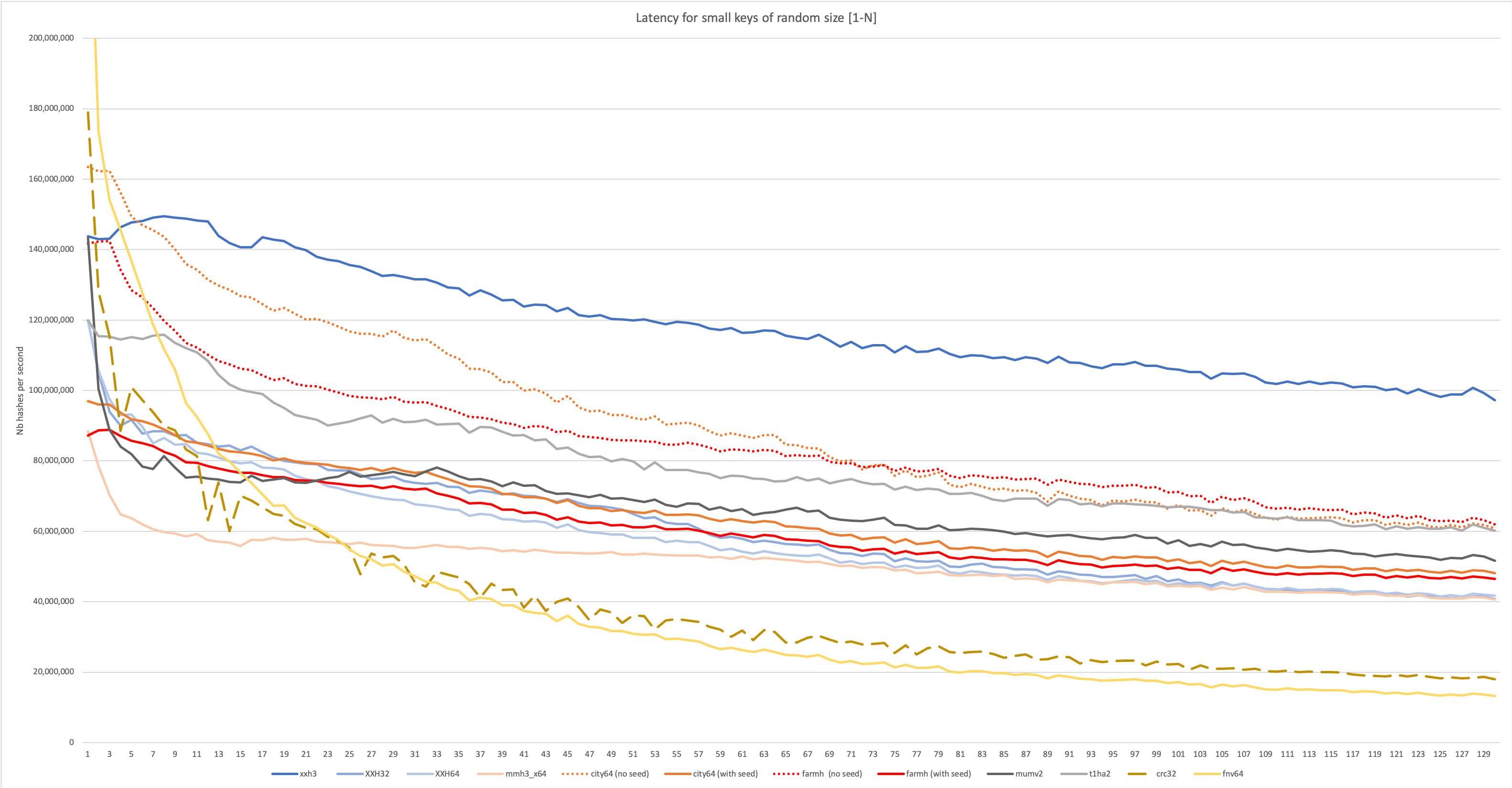
For a more detailed analysis, see the performance comparison on the wiki.
xxHash is not a cryptographic hash function. Do not use it for signatures, password storage, or any other purpose that requires resistance to attacks.
| Branch | Status |
|---|---|
| release |  |
| dev |  |
The default make target builds both the library and the xxhsum command line utility:
make
./xxhsum -H3 README.md
The library can then be linked as libxxhash, or compiled directly from xxhash.c. For a header-only integration, define XXH_INLINE_ALL before including xxhash.h:
#define XXH_INLINE_ALL
#include "xxhash.h"
For CMake integration, see the CMake guide. The xxhsum manual documents checksum generation, verification, benchmarking and advanced command line options.
The simplest API hashes a contiguous block of memory in a single call:
#include <stddef.h>
#include "xxhash.h"

XXH64_hash_t hash_buffer(const void* buffer, size_t size)
{
    return XXH3_64bits(buffer, size);
}
The API also supports incremental hashing of streams of unknown size. Complete single-shot and streaming examples are provided in the documented API header.
Speed is not the only property that matters. For non-adversarial inputs, xxHash aims to produce a uniform distribution so that any subset of the output bits can spread entries evenly in a table or index. Like any fixed-width hash, it is still subject to collisions and the birthday paradox.
All variants successfully complete Austin Appleby's SMHasher test suite, providing a baseline measure of statistical quality. Additional tests that evaluate speed and collision properties more thoroughly are also provided.
Finally, xxHash provides its own massive collision tester, able to generate and compare billions of hashes to test the limits of 64-bit hash algorithms. On this front too, xxHash features good results, in line with the birthday paradox. A more detailed analysis is documented in the wiki.
xxHash is available from many package managers. With vcpkg, install the library with:
vcpkg install xxhash
Add the xxhsum feature to install the command line utility as well:
vcpkg install "xxhash[xxhsum]"
The current package versions available across distributions are tracked by Repology.

The following macros can be set at compilation time to modify libxxhash's behavior. They are generally disabled by default.
XXH_INLINE_ALL: Make all functions inline, implementation is directly included within xxhash.h. Inlining functions is beneficial for speed, notably for small keys. It‘s extremely effective when key’s length is expressed as a compile time constant, with performance improvements observed in the +200% range . See this article for details.XXH_PRIVATE_API: same outcome as XXH_INLINE_ALL. Still available for legacy support. The name underlines that XXH_* symbol names will not be exported.XXH_STATIC_LINKING_ONLY: gives access to internal state declaration, required for static allocation. Incompatible with dynamic linking, due to risks of ABI changes.XXH_NAMESPACE: Prefixes all symbols with the value of XXH_NAMESPACE. This macro can only use compilable character set. Useful to evade symbol naming collisions, in case of multiple inclusions of xxHash's source code. Client applications still use the regular function names, as symbols are automatically translated through xxhash.h.XXH_FORCE_ALIGN_CHECK: Use a faster direct read path when input is aligned. This option can result in dramatic performance improvement on architectures unable to load memory from unaligned addresses when input to hash happens to be aligned on 32 or 64-bit boundaries. It is (slightly) detrimental on platform with good unaligned memory access performance (same instruction for both aligned and unaligned accesses). This option is automatically disabled on x86, x64 and aarch64, and enabled on all other platforms.XXH_FORCE_MEMORY_ACCESS: The default method 0 uses a portable memcpy() notation. Method 1 uses a gcc-specific packed attribute, which can provide better performance for some targets. Method 2 forces unaligned reads, which is not standard compliant, but might sometimes be the only way to extract better read performance. Method 3 uses a byteshift operation, which is best for old compilers which don't inline memcpy() or big-endian systems without a byteswap instruction.XXH_CPU_LITTLE_ENDIAN: By default, endianness is determined by a runtime test resolved at compile time. If, for some reason, the compiler cannot simplify the runtime test, it can cost performance. It's possible to skip auto-detection and simply state that the architecture is little-endian by setting this macro to 1. Setting it to 0 states big-endian.XXH_ENABLE_AUTOVECTORIZE: Auto-vectorization may be triggered for XXH32 and XXH64, depending on cpu vector capabilities and compiler version. Note: auto-vectorization tends to be triggered more easily with recent versions of clang. For XXH32, SSE4.1 or equivalent (NEON) is enough, while XXH64 requires AVX512. Unfortunately, auto-vectorization is generally detrimental to XXH performance. For this reason, the xxhash source code tries to prevent auto-vectorization by default. That being said, systems evolve, and this conclusion may change. For example, it has been reported that recent Zen4 cpus are more likely to improve performance with vectorization. Therefore, should you prefer or want to test vectorized code, you can enable this flag: it will remove the no-vectorization protection code, thus making it more likely for XXH32 and XXH64 to be auto-vectorized.XXH32_ENDJMP: Switch multi-branch finalization stage of XXH32 by a single jump. This is generally undesirable for performance, especially when hashing inputs of random sizes. But depending on exact architecture and compiler, a jump might provide slightly better performance on small inputs. Disabled by default.XXH_IMPORT: MSVC specific: should only be defined for dynamic linking, as it prevents linkage errors.XXH_NO_STDLIB: Disable invocation of <stdlib.h> functions, notably malloc() and free(). libxxhash's XXH*_createState() will always fail and return NULL. But one-shot hashing (like XXH32()) or streaming using statically allocated states still work as expected. This build flag is useful for embedded environments without dynamic allocation.XXH_memcpy, XXH_memset, XXH_memcmp : redirect memcpy(), memset() and memcmp() to some user-selected symbol at compile time. Redirecting all 3 removes the need to include <string.h> standard library.XXH_NO_EXTERNC_GUARD: When xxhash.h is compiled in C++ mode, removes the extern "C" { .. } block guard.XXH_DEBUGLEVEL : When set to any value >= 1, enables assert() statements. This (slightly) slows down execution, but may help finding bugs during debugging sessions.XXH_NO_XXH3 : removes symbols related to XXH3 (both 64 & 128 bits) from generated binary. XXH3 is by far the largest contributor to libxxhash size, so it's useful to reduce binary size for applications which do not employ XXH3.XXH_NO_LONG_LONG: removes compilation of algorithms relying on 64-bit long long types which include XXH3 and XXH64. Only XXH32 will be compiled. Useful for targets (architectures and compilers) without 64-bit support.XXH_NO_STREAM: Disables the streaming API, limiting the library to single shot variants only.XXH_NO_INLINE_HINTS: By default, xxHash uses __attribute__((always_inline)) and __forceinline to improve performance at the cost of code size. Defining this macro to 1 will mark all internal functions as static, allowing the compiler to decide whether to inline a function or not. This is very useful when optimizing for smallest binary size, and is automatically defined when compiling with -O0, -Os, -Oz, or -fno-inline on GCC and Clang. It may also be required to successfully compile using -Og, depending on compiler version.XXH_SIZE_OPT: 0: default, optimize for speed 1: default for -Os and -Oz: disables some speed hacks for size optimization 2: makes code as small as possible, performance may cryXXH_VECTOR : manually select a vector instruction set (default: auto-selected at compilation time). Available instruction sets are XXH_SCALAR, XXH_SSE2, XXH_AVX2, XXH_AVX512, XXH_NEON and XXH_VSX. Compiler may require additional flags to ensure proper support (for example, gcc on x86_64 requires -mavx2 for AVX2, or -mavx512f for AVX512).XXH_PREFETCH_DIST : select prefetching distance. For close-to-metal adaptation to specific hardware platforms. XXH3 only.XXH_NO_PREFETCH : disable prefetching. Some platforms or situations may perform better without prefetching. XXH3 only.xxhsum CLIXXH_1ST_SPEED_TARGET : select an initial speed target, expressed in MiB/s, for the first speed test in benchmark mode. Benchmark will adjust the target at subsequent iterations, but the first test is made “blindly” by targeting this speed. Currently conservatively set to 10 MiB/s, to support very slow (emulated) platforms.The following variables control runtime dispatch when building with make:
DISPATCH=1 : use xxh_x86dispatch.c in the Command Line Interface xxhsum, selecting at runtime between scalar, sse2, avx2 or avx512 instruction sets. This option is only valid for x86/x64 systems. It is enabled by default when an x86/x64 target is detected. It can be forcefully turned off using DISPATCH=0.LIBXXH_DISPATCH=1 : enable the same runtime dispatch in both the static and dynamic libxxhash libraries. This option is only valid for x86/x64 systems and is disabled by default. It is generally expected that library users will frequently hash short inputs, for which inlining is important and runtime dispatch may be detrimental, so this variable is disabled by default. It can nonetheless be explicitly selected. When enabled, the symbols declared in xxh_x86dispatch.h are included in the libraries and the header is installed. Applications must include this header to redirect the XXH3 entry points to their dispatched variants.NODE_JS=1 : When compiling xxhsum for Node.js with Emscripten, this links the NODERAWFS library for unrestricted filesystem access and patches isatty to make the command line utility correctly detect the terminal. This does make the binary specific to Node.js.The library files xxhash.c and xxhash.h are licensed under the BSD 2-Clause License. The xxhsum command line utility is licensed under GPLv2.
Beyond the C reference version, xxHash is also available from many different programming languages, thanks to great contributors. They are listed on the xxHash website.
xxhsum -c and great support during early xxh releasesXXH64XXH3 and XXH128