| [](https://travis-ci.org/WebAssembly/binaryen) |
| [](https://ci.appveyor.com/project/WebAssembly/binaryen/branch/master) |
| |
| # Binaryen |
| |
| Binaryen is a compiler and toolchain infrastructure library for WebAssembly, |
| written in C++. It aims to make [compiling to WebAssembly] **easy, fast, and |
| effective**: |
| |
| * **Easy**: Binaryen has a simple [C API] in a single header, and can also be |
| [used from JavaScript][JS_API]. It accepts input in [WebAssembly-like |
| form][compile_to_wasm] but also accepts a general [control flow graph] for |
| compilers that prefer that. |
| |
| * **Fast**: Binaryen's internal IR uses compact data structures and is designed |
| for completely parallel codegen and optimization, using all available CPU |
| cores. Binaryen's IR also compiles down to WebAssembly extremely easily and |
| quickly because it is essentially a subset of WebAssembly. |
| |
| * **Effective**: Binaryen's optimizer has many [passes] that can improve code |
| very significantly (e.g. local coloring to coalesce local variables; dead |
| code elimination; precomputing expressions when possible at compile time; |
| etc.). These optimizations aim to make Binaryen powerful enough to be used as |
| a [compiler backend][backend] by itself. One specific area of focus is on |
| WebAssembly-specific optimizations (that general-purpose compilers might not |
| do), which you can think of as wasm [minification] , similar to minification |
| for JavaScript, CSS, etc., all of which are language-specific (an example of |
| such an optimization is block return value generation in `SimplifyLocals`). |
| |
| Compilers built using Binaryen include |
| |
| * [`asm2wasm`](https://github.com/WebAssembly/binaryen/blob/master/src/asm2wasm.h) which compiles asm.js to WebAssembly |
| * [`AssemblyScript`](https://github.com/AssemblyScript/assemblyscript) which compiles TypeScript to Binaryen IR |
| * [`wasm2js`](https://github.com/WebAssembly/binaryen/blob/master/src/wasm2js.h) which compiles WebAssembly to JS |
| * [`Asterius`](https://github.com/tweag/asterius) which compiles Haskell to WebAssembly |
| |
| Binaryen also provides a set of **toolchain utilities** that can |
| |
| * **Parse** and **emit** WebAssembly. In particular this lets you load |
| WebAssembly, optimize it using Binaryen, and re-emit it, thus implementing a |
| wasm-to-wasm optimizer in a single command. |
| * **Interpret** WebAssembly as well as run the WebAssembly spec tests. |
| * Integrate with **[Emscripten](http://emscripten.org)** in order to provide a |
| complete compiler toolchain from C and C++ to WebAssembly. |
| * **Polyfill** WebAssembly by running it in the interpreter compiled to |
| JavaScript, if the browser does not yet have native support (useful for |
| testing). |
| |
| Consult the [contributing instructions](Contributing.md) if you're interested in |
| participating. |
| |
| ## Binaryen IR |
| |
| Binaryen's internal IR is designed to be |
| |
| * **Flexible and fast** for optimization. |
| * **As close as possible to WebAssembly** so it is simple and fast to convert |
| it to and from WebAssembly. |
| |
| There are a few differences between Binaryen IR and the WebAssembly language: |
| |
| * Tree structure |
| * Binaryen IR [is a tree][binaryen_ir], i.e., it has hierarchical structure, |
| for convenience of optimization. This differs from the WebAssembly binary |
| format which is a stack machine. |
| * Consequently Binaryen's text format allows only s-expressions. |
| WebAssembly's official text format is primarily a linear instruction list |
| (with s-expression extensions). Binaryen can't read the linear style, but |
| it can read a wasm text file if it contains only s-expressions. |
| * Binaryen uses Stack IR to optimize "stacky" code (that can't be |
| represented in structured form). |
| * In rare cases stacky code must be represented in Binaryen IR as well, like |
| popping a value in an exception catch. To support that Binaryen IR has |
| `push` and `pop` instructions. |
| * Types and unreachable code |
| * WebAssembly limits block/if/loop types to none and the concrete value types |
| (i32, i64, f32, f64). Binaryen IR has an unreachable type, and it allows |
| block/if/loop to take it, allowing [local transforms that don't need to |
| know the global context][unreachable]. As a result, Binaryen's default |
| text output is not necessarily valid wasm text. (To get valid wasm text, |
| you can do `--generate-stack-ir --print-stack-ir`, which prints Stack IR, |
| this is guaranteed to be valid for wasm parsers.) |
| * Binaryen ignores unreachable code when reading WebAssembly binaries. That |
| means that if you read a wasm file with unreachable code, that code will be |
| discarded as if it were optimized out (often this is what you want anyhow, |
| and optimized programs have no unreachable code anyway, but if you write an |
| unoptimized file and then read it, it may look different). The reason for |
| this behavior is that unreachable code in WebAssembly has corner cases that |
| are tricky to handle in Binaryen IR (it can be very unstructured, and |
| Binaryen IR is more structured than WebAssembly as noted earlier). Note |
| that Binaryen does support unreachable code in .wat text files, since as we |
| saw Binaryen only supports s-expressions there, which are structured. |
| * Blocks |
| * Binaryen IR has only one node that contains a variable-length list of |
| operands: the block. WebAssembly on the other hand allows lists in loops, |
| if arms, and the top level of a function. Binaryen's IR has a single |
| operand for all non-block nodes; this operand may of course be a block. |
| The motivation for this property is that many passes need special code |
| for iterating on lists, so having a single IR node with a list simplifies |
| them. |
| * As in wasm, blocks and loops may have names. Branch targets in the IR are |
| resolved by name (as opposed to nesting depth). This has 2 consequences: |
| * Blocks without names may not be branch targets. |
| * Names are required to be unique. (Reading .wat files with duplicate names |
| is supported; the names are modified when the IR is constructed). |
| * As an optimization, a block that is the child of a loop (or if arm, or |
| function toplevel) and which has no branches targeting it will not be |
| emitted when generating wasm. Instead its list of operands will be directly |
| used in the containing node. Such a block is sometimes called an "implicit |
| block". |
| * Multivalue |
| * Binaryen will not represent multivalue instructions and values directly. |
| Binaryen's main focus is on optimization of wasm, and therefore the question |
| of whether we should have multivalue in the main IR is whether it justifes |
| the extra complexity there. Experiments show that the shrinking of code |
| size thanks to multivalue is useful but small, just 1-3% or so. Given that, |
| we prefer to keep the main IR simple, and focus on multivalue optimizations |
| in Stack IR, which is more suitable for such things. |
| * Binaryen does still need to implement the "ABI" level of multivalue, that |
| is, we need multivalue calls because those may cross module boundaries, |
| and so they are observable externally. To support that, Binaryen may use |
| `push` and `pop` as mentioned earlier; another option is to add LLVM-like |
| `extractvalue/composevalue` instructions. |
| |
| As a result, you might notice that round-trip conversions (wasm => Binaryen IR |
| => wasm) change code a little in some corner cases. |
| |
| * When optimizing Binaryen uses an additional IR, Stack IR (see |
| `src/wasm-stack.h`). Stack IR allows a bunch of optimizations that are |
| tailored for the stack machine form of WebAssembly's binary format (but Stack |
| IR is less efficient for general optimizations than the main Binaryen IR). If |
| you have a wasm file that has been particularly well-optimized, a simple |
| round-trip conversion (just read and write, without optimization) may cause |
| more noticeable differences, as Binaryen fits it into Binaryen IR's more |
| structured format. If you also optimize during the round-trip conversion then |
| Stack IR opts will be run and the final wasm will be better optimized. |
| |
| Notes when working with Binaryen IR: |
| |
| * As mentioned above, Binaryen IR has a tree structure. As a result, each |
| expression should have exactly one parent - you should not "reuse" a node by |
| having it appear more than once in the tree. The motivation for this |
| limitation is that when we optimize we modify nodes, so if they appear more |
| than once in the tree, a change in one place can appear in another |
| incorrectly. |
| * For similar reasons, nodes should not appear in more than one functions. |
| |
| ## Tools |
| |
| This repository contains code that builds the following tools in `bin/`: |
| |
| * **wasm-opt**: Loads WebAssembly and runs Binaryen IR passes on it. |
| * **wasm-as**: Assembles WebAssembly in text format (currently S-Expression |
| format) into binary format (going through Binaryen IR). |
| * **wasm-dis**: Un-assembles WebAssembly in binary format into text format |
| (going through Binaryen IR). |
| * **wasm2js**: A WebAssembly-to-JS compiler. This is used by Emscripten to |
| generate JavaScript as an alternative to WebAssembly. |
| * **wasm-shell**: A shell that can load and interpret WebAssembly code. It can |
| also run the spec test suite. |
| * **wasm-emscripten-finalize**: Takes a wasm binary produced by llvm+lld and |
| performs emscripten-specific passes over it. |
| * **asm2wasm**: An asm.js-to-WebAssembly compiler, using Emscripten's asm |
| optimizer infrastructure. This is used by Emscripten in Binaryen mode when it |
| uses Emscripten's fastcomp asm.js backend. |
| * **wasm-ctor-eval**: A tool that can execute C++ global constructors ahead of |
| time. Used by Emscripten. |
| * **binaryen.js**: A standalone JavaScript library that exposes Binaryen methods for [creating and optimizing WASM modules](https://github.com/WebAssembly/binaryen/blob/master/test/binaryen.js/hello-world.js). For builds, see [binaryen.js on npm](https://www.npmjs.com/package/binaryen) (or download it directly from [github](https://raw.githubusercontent.com/AssemblyScript/binaryen.js/master/index.js), [rawgit](https://cdn.rawgit.com/AssemblyScript/binaryen.js/master/index.js), or [unpkg](https://unpkg.com/binaryen@latest/index.js)). |
| |
| Usage instructions for each are below. |
| |
| ## Building |
| |
| ``` |
| cmake . && make |
| ``` |
| Note that you can also use `ninja` as your generator: `cmake -G Ninja . && ninja` |
| |
| * A C++11 compiler is required. |
| * The JavaScript components can be built using `build-js.sh`, see notes inside. Normally this is not needed as builds are provided in this repo already. |
| |
| If you also want to compile C/C++ to WebAssembly (and not just asm.js to WebAssembly), you'll need Emscripten. You'll need the `incoming` branch there (which you can get via [the SDK](http://kripken.github.io/emscripten-site/docs/getting_started/downloads.html)), for more details see [the wiki](https://github.com/kripken/emscripten/wiki/WebAssembly). |
| |
| ### Visual C++ |
| |
| 1. Using the Microsoft Visual Studio Installer, install the "Visual C++ tools for CMake" component. |
| |
| 1. Generate the projects: |
| |
| ``` |
| mkdir build |
| cd build |
| "%VISUAL_STUDIO_ROOT%\Common7\IDE\CommonExtensions\Microsoft\CMake\CMake\bin\cmake.exe" .. |
| ``` |
| |
| Substitute VISUAL_STUDIO_ROOT with the path to your Visual Studio |
| installation. In case you are using the Visual Studio Build Tools, the path |
| will be "C:\Program Files (x86)\Microsoft Visual Studio\2017\BuildTools". |
| |
| 1. From the Developer Command Prompt, build the desired projects: |
| |
| ``` |
| msbuild binaryen.vcxproj |
| ``` |
| |
| CMake generates a project named "ALL_BUILD.vcxproj" for conveniently building all the projects. |
| |
| ## Running |
| |
| ### wasm-opt |
| |
| Run |
| |
| ```` |
| bin/wasm-opt [.wasm or .wat file] [options] [passes, see --help] [--help] |
| ```` |
| |
| The wasm optimizer receives WebAssembly as input, and can run transformation |
| passes on it, as well as print it (before and/or after the transformations). For |
| example, try |
| |
| ```` |
| bin/wasm-opt test/passes/lower-if-else.wast --print |
| ```` |
| |
| That will pretty-print out one of the test cases in the test suite. To run a |
| transformation pass on it, try |
| |
| ```` |
| bin/wasm-opt test/passes/lower-if-else.wast --print --lower-if-else |
| ```` |
| |
| The `lower-if-else` pass lowers if-else into a block and a break. You can see |
| the change the transformation causes by comparing the output of the two print |
| commands. |
| |
| It's easy to add your own transformation passes to the shell, just add `.cpp` |
| files into `src/passes`, and rebuild the shell. For example code, take a look at |
| the [`lower-if-else` pass](https://github.com/WebAssembly/binaryen/blob/master/src/passes/LowerIfElse.cpp). |
| |
| Some more notes: |
| |
| * See `bin/wasm-opt --help` for the full list of options and passes. |
| * Passing `--debug` will emit some debugging info. |
| |
| ### wasm2js |
| |
| Run |
| |
| ``` |
| bin/wasm2js [input.wasm file] |
| ``` |
| |
| This will print out JavaScript to the console. |
| |
| For example, try |
| |
| ``` |
| $ bin/wasm2js test/hello_world.wast |
| ``` |
| |
| That output contains |
| |
| ``` |
| function add(x, y) { |
| x = x | 0; |
| y = y | 0; |
| return x + y | 0 | 0; |
| } |
| ``` |
| |
| as a translation of |
| |
| ``` |
| (func $add (; 0 ;) (type $0) (param $x i32) (param $y i32) (result i32) |
| (i32.add |
| (local.get $x) |
| (local.get $y) |
| ) |
| ) |
| ``` |
| |
| wasm2js's output is in ES6 module format - basically, it converts a wasm |
| module into an ES6 module (to run on older browsers and Node.js versions |
| you can use Babel etc. to convert it to ES5). Let's look at a full example |
| of calling that hello world wast; first, create the main JS file: |
| |
| ```javascript |
| // main.mjs |
| import { add } from "./hello_world.mjs"; |
| console.log('the sum of 1 and 2 is:', add(1, 2)); |
| ``` |
| |
| The run this (note that you need a new enough Node.js with ES6 module |
| support): |
| |
| ```shell |
| $ bin/wasm2js test/hello_world.wast -o hello_world.mjs |
| $ node --experimental-modules main.mjs |
| the sum of 1 and 2 is: 3 |
| ``` |
| |
| Things keep to in mind with wasm2js's output: |
| |
| * You should run wasm2js with optimizations for release builds, using `-O` |
| or another optimization level. That will optimize along the entire pipeline |
| (wasm and JS). It won't do everything a JS minifer would, though, like |
| minify whitespace, so you should still run a normal JS minifer afterwards. |
| * It is not possible to match WebAssembly semantics 100% precisely with fast |
| JavaScript code. For example, every load and store may trap, and to make |
| JavaScript do the same we'd need to add checks everywhere, which would be |
| large and slow. Instead, wasm2js assumes loads and stores do not trap, that |
| int/float conversions do not trap, and so forth. There may also be slight |
| differences in corner cases of conversions, like non-trapping float to int. |
| |
| ### asm2wasm |
| |
| Run |
| |
| ``` |
| bin/asm2wasm [input.asm.js file] |
| ``` |
| |
| This will print out a WebAssembly module in s-expression format to the console. |
| |
| For example, try |
| |
| ``` |
| $ bin/asm2wasm test/hello_world.asm.js |
| ``` |
| |
| That input file contains |
| |
| ```javascript |
| function () { |
| "use asm"; |
| function add(x, y) { |
| x = x | 0; |
| y = y | 0; |
| return x + y | 0; |
| } |
| return { add: add }; |
| } |
| ``` |
| |
| You should see something like this: |
| |
| 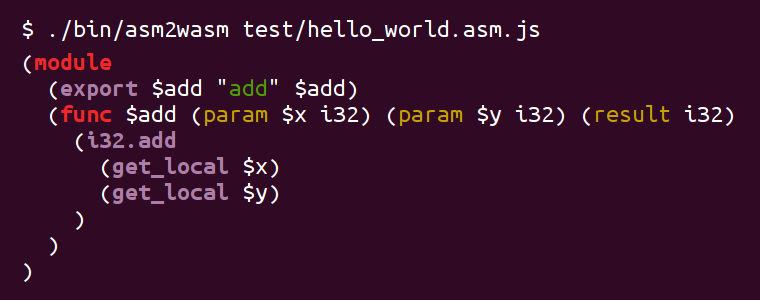 |
| |
| By default you should see pretty colors as in that image. Set `COLORS=0` in the |
| env to disable colors if you prefer that. On Linux and Mac, you can set |
| `COLORS=1` in the env to force colors (useful when piping to `more`, for |
| example). For Windows, pretty colors are only available when `stdout/stderr` are |
| not redirected/piped. |
| |
| Pass `--debug` on the command line to see debug info, about asm.js functions as |
| they are parsed, etc. |
| |
| ### C/C++ Source ⇒ asm2wasm ⇒ WebAssembly |
| |
| When using `emcc` with the `BINARYEN` option, it will use Binaryen to build to |
| WebAssembly. This lets you compile C and C++ to WebAssembly, with emscripten |
| using asm.js internally as a build step. Since emscripten's asm.js generation is |
| very stable, and asm2wasm is a fairly simple process, this method of compiling C |
| and C++ to WebAssembly is usable already. See the [emscripten |
| wiki](https://github.com/kripken/emscripten/wiki/WebAssembly) for more details |
| about how to use it. |
| |
| ## Testing |
| |
| ``` |
| ./check.py |
| ``` |
| |
| (or `python check.py`) will run `wasm-shell`, `wasm-opt`, `asm2wasm`, etc. on the testcases in `test/`, and verify their outputs. |
| |
| The `check.py` script supports some options: |
| |
| ``` |
| ./check.py [--interpreter=/path/to/interpreter] [TEST1] [TEST2].. |
| ``` |
| |
| * If an interpreter is provided, we run the output through it, checking for |
| parse errors. |
| * If tests are provided, we run exactly those. If none are provided, we run |
| them all. To see what tests are available, run `./check.py --list-suites`. |
| * Some tests require `emcc` or `nodejs` in the path. They will not run if the |
| tool cannot be found, and you'll see a warning. |
| * We have tests from upstream in `tests/spec`, in git submodules. Running |
| `./check.py` should update those. |
| |
| ## Design Principles |
| |
| * **Interned strings for names**: It's very convenient to have names on nodes, |
| instead of just numeric indices etc. To avoid most of the performance |
| difference between strings and numeric indices, all strings are interned, |
| which means there is a single copy of each string in memory, string |
| comparisons are just a pointer comparison, etc. |
| * **Allocate in arenas**: Based on experience with other |
| optimizing/transformating toolchains, it's not worth the overhead to |
| carefully track memory of individual nodes. Instead, we allocate all elements |
| of a module in an arena, and the entire arena can be freed when the module is |
| no longer needed. |
| |
| ## FAQ |
| |
| * Why the weird name for the project? |
| |
| "Binaryen" is a combination of **binary** - since WebAssembly is a binary format |
| for the web - and **Emscripten** - with which it can integrate in order to |
| compile C and C++ all the way to WebAssembly, via asm.js. Binaryen began as |
| Emscripten's WebAssembly processing library (`wasm-emscripten`). |
| |
| "Binaryen" is pronounced [in the same manner](http://www.makinggameofthrones.com/production-diary/2011/2/11/official-pronunciation-guide-for-game-of-thrones.html) as "[Targaryen](https://en.wikipedia.org/wiki/List_of_A_Song_of_Ice_and_Fire_characters#House_Targaryen)": *bi-NAIR-ee-in*. Or something like that? Anyhow, however Targaryen is correctly pronounced, they should rhyme. Aside from pronunciation, the Targaryen house words, "Fire and Blood", have also inspired Binaryen's: "Code and Bugs." |
| |
| * Does it compile under Windows and/or Visual Studio? |
| |
| Yes, it does. Here's a step-by-step [tutorial][win32] on how to compile it |
| under **Windows 10 x64** with with **CMake** and **Visual Studio 2015**. Help |
| would be appreciated on Windows and OS X as most of the core devs are on Linux. |
| |
| [compiling to WebAssembly]: https://github.com/WebAssembly/binaryen/wiki/Compiling-to-WebAssembly-with-Binaryen |
| [win32]: https://github.com/brakmic/bazaar/blob/master/webassembly/COMPILING_WIN32.md |
| [C API]: https://github.com/WebAssembly/binaryen/wiki/Compiling-to-WebAssembly-with-Binaryen#c-api-1 |
| [control flow graph]: https://github.com/WebAssembly/binaryen/wiki/Compiling-to-WebAssembly-with-Binaryen#cfg-api |
| [JS_API]: https://github.com/WebAssembly/binaryen/wiki/binaryen.js-API |
| [compile_to_wasm]: https://github.com/WebAssembly/binaryen/wiki/Compiling-to-WebAssembly-with-Binaryen#what-do-i-need-to-have-in-order-to-use-binaryen-to-compile-to-webassembly |
| [passes]: https://github.com/WebAssembly/binaryen/tree/master/src/passes |
| [backend]: https://kripken.github.io/talks/binaryen.html#/9 |
| [minification]: https://kripken.github.io/talks/binaryen.html#/2 |
| [unreachable]: https://github.com/WebAssembly/binaryen/issues/903 |
| [binaryen_ir]: https://github.com/WebAssembly/binaryen/issues/663 |
