| commit | 9ebebdef98a6aacfbedcf2ca61ba0eaecc2563f4 | [log] [tgz] |
|---|---|---|
| author | Colin Watson <cjwatson@debian.org> | Mon Feb 17 00:41:30 2025 |
| committer | Colin Watson <cjwatson@debian.org> | Mon Feb 17 00:41:30 2025 |
| tree | d3cff4498b519c6f3ca5ba5bba516ad46c107ac3 | |
| parent | 507409661335bd3dd8a7e39f04d07b42e519becc [diff] |
Regenerate test certificates

Created using the following command with OpenSSL 3.4.0:

    for cert in expired mtls valid/server; do
        make -C tests/certs/$cert clean all
    done
Requests is a simple, yet elegant, HTTP library.
>>> import requests
>>> r = requests.get('https://httpbin.org/basic-auth/user/pass', auth=('user', 'pass'))
>>> r.status_code
200
>>> r.headers['content-type']
'application/json; charset=utf8'
>>> r.encoding
'utf-8'
>>> r.text
'{"authenticated": true, ...'
>>> r.json()
{'authenticated': True, ...}
Requests allows you to send HTTP/1.1 requests extremely easily. There’s no need to manually add query strings to your URLs, or to form-encode your PUT & POST data — but nowadays, just use the json method!
Requests is one of the most downloaded Python packages today, pulling in around 30M downloads / week— according to GitHub, Requests is currently depended upon by 1,000,000+ repositories. You may certainly put your trust in this code.



Requests is available on PyPI:
$ python -m pip install requests
Requests officially supports Python 3.8+.
Requests is ready for the demands of building robust and reliable HTTP–speaking applications, for the needs of today.
dict–like Cookies.netrc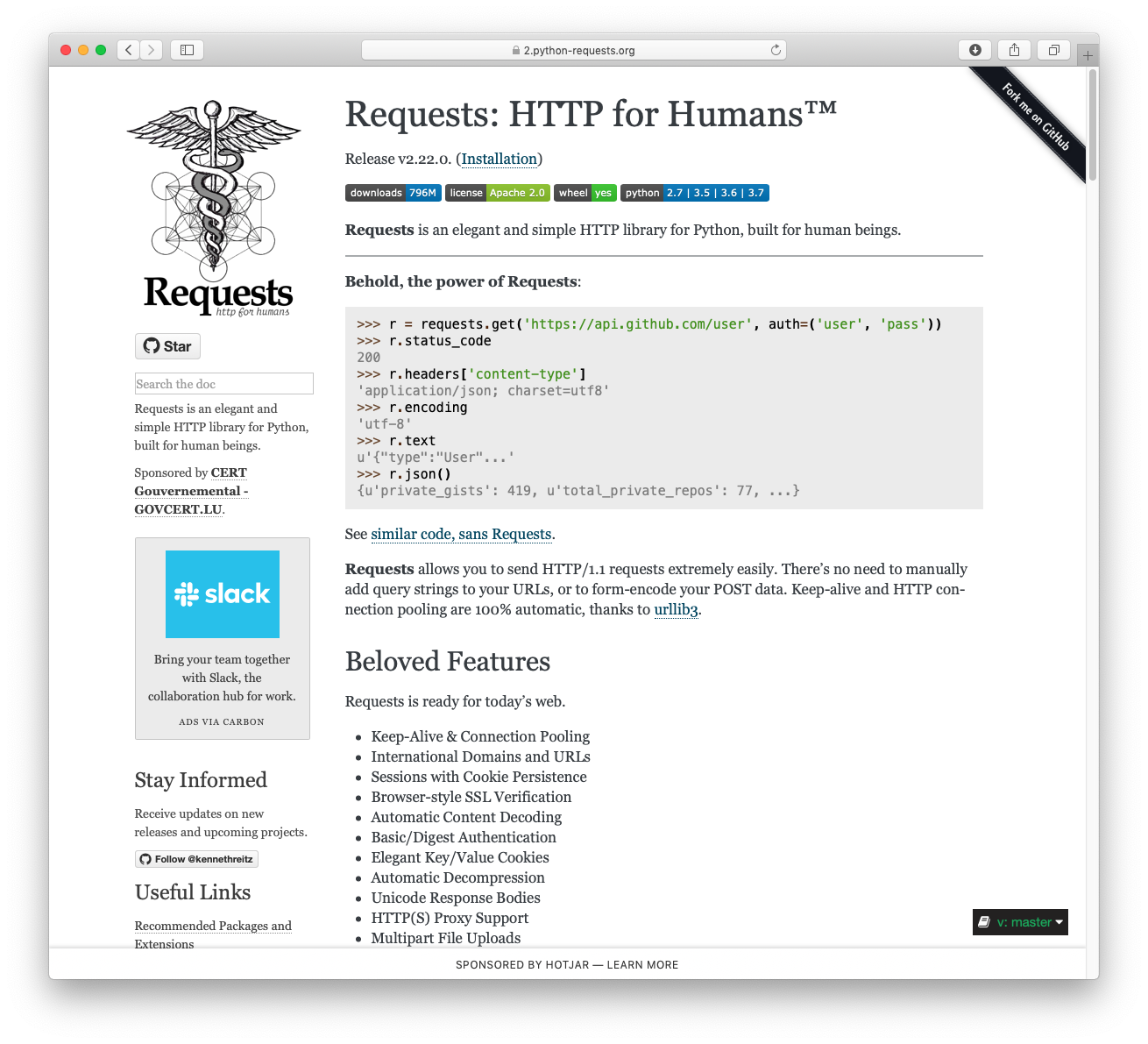
When cloning the Requests repository, you may need to add the -c fetch.fsck.badTimezone=ignore flag to avoid an error about a bad commit (see this issue for more background):
git clone -c fetch.fsck.badTimezone=ignore https://github.com/psf/requests.git
You can also apply this setting to your global Git config:
git config --global fetch.fsck.badTimezone ignore